Bliffendorf Opera House
The Magician's ElephantThe Bliffendorf Opera House is the setting of the accident that makes the elephant a public fact in Baltese and turns an act of failed magic into a question of responsibility. Its damaged roof marks the point where the extraordinary breaks into ordinary civic life: an elephant falls from above, a noblewoman is injured, and officials must decide what to do with a creature the law has no clear instructions for.
Setting and the conjuring
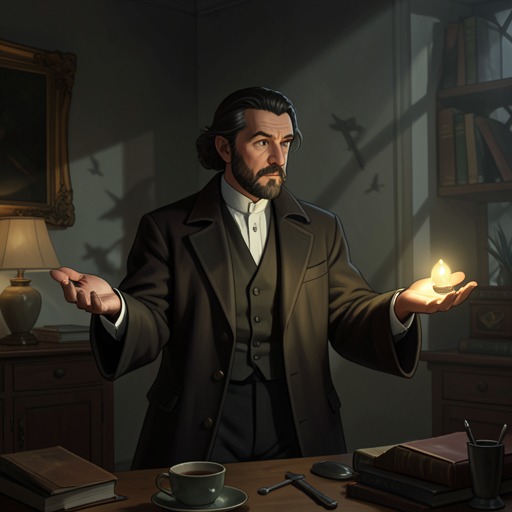
The opera house stands not far from Apartments Polonaise, across the rooftops from the winter darkness. On the evening of the accident, a magician of advanced years and failing reputation performs there what becomes the most astonishing magic of his career. He intends to conjure a bouquet of lilies, but produces an elephant instead.
The difference between intended spectacle and actual consequence is immediate and physical. The elephant crashes through the ceiling amid plaster dust and roofing tiles, landing in the lap of Bettine LaVaughn, to whom the lilies had been meant as a presentation. The opera house is thus not merely a venue for a remarkable trick: its roof becomes the route by which the impossible enters the city, and its destruction makes the magician’s mistake impossible to keep within the bounds of performance.
Injury and public account
The impact crushes Bettine LaVaughn’s legs. She is thereafter confined to a wheelchair, and the accident remains central to how she presents her misfortune to others, even in conversations unrelated to elephants or roofs. The injury gives the spectacle a lasting human cost, while the image of an elephant arriving through the ceiling makes the event difficult for listeners to believe.
That disbelief is visible when Peter Augustus Duchene hears the report in the fish market. The fishmonger describes the elephant coming through the opera-house ceiling and landing on a noblewoman named LaVaughn. Peter reacts to the word elephant as an impossibility made audible, then repeats it under his breath. The venue’s accident has already traveled beyond the damaged building as rumor, carrying both the startling fact and the injury that makes it consequential.
From damaged roof to legal problem
The opera house’s destruction creates a problem the chief of police cannot resolve by consulting the handbook. He finds no provision for a beast that appeared from nowhere, destroyed an opera-house roof, and crippled a noblewoman. The absence of a rule turns the building’s damage into a test of how officials interpret law when an unprecedented event does not fit its categories.
One policeman proposes treating the elephant as a criminal, on the ground that she caused the damage and injury. Leo Matienne challenges that reasoning by separating physical cause from culpability: if a magician threw a rock through a window, he argues, the rock would not be blamed for the broken glass. The elephant, he adds, did not ask to crash through the roof. The opera-house accident therefore opens a dispute not only about property and punishment but about whether an animal can be guilty of harm brought about without her choice.
Consequences beyond the building
The magician is imprisoned at Bettine LaVaughn’s behest. The opera house’s owner receives enough money from Countess Quintet to repair and retile the roof a dozen times over, a compensation that addresses the building’s material damage without settling the larger question of what should happen to the elephant. She is later taken to the countess’s home, where an enlarged, brightly painted door is made to admit her and she becomes the countess’s property.
The opera house consequently remains the accident’s point of origin even after the plot moves elsewhere. Its roof can be repaired, but the event there sets in motion the elephant’s confinement, the magician’s imprisonment, and a debate over the difference between causing harm and deserving punishment. The building’s significance lies in that rupture: a planned bouquet gives way to a falling elephant, and a venue for performance becomes the place where the city’s assumptions about law and responsibility are put under pressure.